
1.1.2. Governance
Good governance, due diligence statement and corporate conduct policies
ESRS 2 GOV-4, ESRS 1 section 4
Good corporate governance and due diligence are essential factors for generating value, improving economic efficiency, integrating businesses, and strengthening the confidence of shareholders and other stakeholders, through the appropriate division of functions, duties, and responsibilities among the company's governing and management bodies.
a) Integration of due diligence into governance, strategy and business model
ESRS 2 MDR-P
Viscofan's business conduct and regulatory compliance system means not only compliance with the law, but also a culture of shared values of tolerance and integrity that extends from the management, leadership and supervisory bodies to all individuals who are part of Viscofan.
Viscofan seeks a continuous management process to identify, prevent, mitigate, and respond to sustainability incidents and risks, both in its own operations and throughout the value chain. The materiality analysis reported in section 1.1.4 of this ESRS identified the materiality incidents, risks, and opportunities, which are further described in the corresponding thematic ESRS.
This process stems from the establishment of regulations and policies, the basis of which is the Articles of Association, the Regulations of the General Shareholders' Meeting, the Regulations of the Board of Directors, and the Regulations of the Board Committees themselves.
Viscofan has general ethical principles and guidelines established by the Group's Code of Conduct and sets out basic common guidelines on Human Rights that constitute the guiding principles of its activity in different areas at the organization. Specifically, the Human Rights policy establishes basic commitments in:
- Prohibition of forced labor.
- Prohibition of child labor.
- Elimination of discrimination in the workplace.
- Respect for freedom of association and collective bargaining.
- Elimination and prevention of harassment and violence.
- Compliance with working conditions.
- Promotion of safety and health at work.
- Environmental protection and pollution prevention.
- To ensure the confidentiality and right to privacy of its employees and stakeholders.
- Take the appropriate measures as soon as possible if a violation of human rights is detected in the facilities, centers or places where the Group companies or their Business Partners carry out their activities, and inform the competent public authorities in accordance with the applicable regulations.
Sustainability Policy
Additionally, the commitment to good governance by the Board of Directors of the Company is manifested in its General Sustainability Policy, modified and approved by the Board of Directors in December 2024 with the aim of adapting its content to the regulatory developments in sustainability in recent years.
The purpose of the policy is to establish the basic principles and commitments that should govern the Group's sustainable development strategy, structured around the following pillars:
- General Due Diligence Duties
- Respect for human and labor rights, diversity and non-discrimination
- Respect for the environment and the fight against climate change
- Ethical and compliance culture: respect for the law, fiscal responsibility, and the fight against corruption and fraud
- Promotion of diversity, equal opportunities and non-discrimination
- Development of the communities in which it operates and of society
- Projection on the value chain
- Stakeholder engagement
Based on this policy, dialogue and communication are key elements. The Viscofan Group promotes strengthening communication and relationship channels with the various stakeholders who interact with the Group, in order to respond to their needs and expectations and foster the creation of shared value.
Furthermore, according to this Policy, accountability to the various stakeholders will be ensured through the issuance of relevant, truthful, complete, reliable and rigorous information that allows for the monitoring of commitments made regarding sustainability.
Furthermore, for communication with the various stakeholders, the Company's corporate website is a fundamental tool, which can be complemented by direct contact with designated staff, particularly through the media, and by contact with analysts where appropriate.
This policy is structured around specific policies in the main areas of action on sustainability that have been described in the relevant thematic ESRS.
This policy applies to all Viscofan Group companies, is available on the company website, and binds all its staff, regardless of their position and function.
Additionally, it establishes that Viscofan will promote the application of the principles and bases of the policy to any natural and/or legal person linked by a relationship other than employment when possible and convenient, in such a way that they follow principles and guidelines consistent with those established in this policy and other sustainable development policies.
The Board of Directors is responsible for monitoring the policy, through supervision by the Appointments, Remuneration and Sustainability Committee regarding the development and implementation of sustainability policies and strategies, and by the Audit Committee regarding the integrity of non-financial information included in the management report, as well as the supervision of non-financial risks arising from the Group's actions in relation to the Policy.
The Group also has an Executive Sustainability Committee whose tasks include promoting sustainability plans and programs in the development of policies, and an Ethics and Regulatory Compliance Committee, under the functional dependence of the Audit Committee, which, in addition to ensuring compliance with the Code of Conduct, manages the reporting channel (Ethics/Integrity Line) that allows employees and other people related to the Company to report any breaches that may occur.
To ensure the company takes action to prevent misconduct, mitigate compliance risks, and effectively protect its people, Viscofan promotes the development of its Regulatory Compliance System. See its description in ESRS G1 Business Conduct.
Furthermore, the roles of the governing, management, and supervisory bodies incorporate key governance elements for good governance in sustainability matters, such as the sustainability competencies of their members, the reporting to them of significant incidents, risks, and opportunities, the application of due diligence, and the integration of sustainability-related performance into the incentive system. These elements are detailed later in the Governance and Sustainability Management subsection of this ESRS.
b) Collaboration with stakeholders
The Viscofan Group understands sustainability as the ability to create value for its various stakeholders in the short, medium, and long term without compromising the well-being of future generations. To achieve this commitment, appropriate communication channels have been identified and established to ensure open dialogue and to stay informed of their needs and expectations. See more details in the section "Stakeholder Interests and Opinions" included in section 1.1.3 of this report.
c) Determination and evaluation of negative impacts on people and the environment
Based on the materiality assessment, the areas where Viscofan has or may have both positive and negative impacts on the environment and people have been identified. These are correlated with the Viscofan Group's detailed management of incidents, risks, and opportunities, as outlined at a general level.
in section 1.1.4. of this ESRS and in particular for each topic in the corresponding sections.
d) Strategy, measures implemented and their effectiveness
In turn, the Viscofan Group's strategy, and in particular its Sustainability Action Plan, establishes specific measures for the identified material aspects to address the issues and monitors their effectiveness based on commitments and indicators. At a general level, the Group's strategy has been detailed in section 1.1.3 of this ESRS, and specifically for each topic in the corresponding sections.
Viscofan adopts a preventive and systematic approach for mitigating and remedying potential adverse environmental and social impacts through, among others, the following processes and tools:
- Due diligence, which allows for the assessment of the impact that current or potential operations may have on local communities and the environment.
- Third-party certified management systems implemented in production units, which comply with international standards such as ISO 14001 (environmental management), ISO 45001 (occupational health and safety) and ISO 50001 (energy management).
- Specific audits focused on social aspects and working conditions.
- Complaint mechanisms accessible to all stakeholders, including communities near the Group's operations.
Viscofan also recognizes and applies the human rights principles of the United Nations Global Compact, the Principles on the Rights of the Child and Business, and the OECD Guidelines for Multinational Enterprises.
The role of the administrative, management and supervisory bodies
ESRS 2 GOV-1, ESRS 2 GOV-2
Viscofan's governance structure is based on two main bodies: the General Shareholders' Meeting and the Board of Directors.
Shareholders and General Meeting
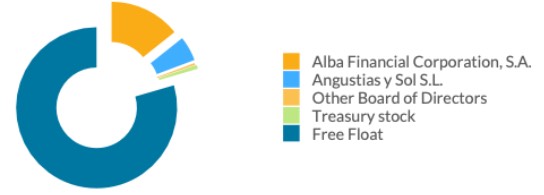
As at December 31, 2025, the Parent Company is aware of the following significant shareholdings:
|
% participation |
|
|
2025 |
|
|
Alba Financial Corporation, S.A. |
14.25 % |
|
Angustias y Sol S.L. |
5.03 % |
|
Other Board of Directors |
0.43 % |
|
Treasury stock |
1.09 % |
|
Free Float |
79.20 % |
The General Shareholders' Meeting is the supreme body of the Company and constitutes the forum where shareholders decide by majority vote on matters within their competence.
Viscofan establishes the principle of “one share, one vote” which promotes equal treatment among the company's shareholders. There is a single class of shares, which grants the same rights and obligations to all shareholders. There are no restrictions on voting, nor is there a limit to the number of votes a single shareholder can cast.
Over the past few years, Viscofan has been promoting a series of initiatives to foster transparency, communication and shareholder participation in the General Meeting, including information on agenda items, an attendance bonus of 0.01 euros per share, facilitating remote voting, electronic voting, an electronic forum and a questionnaire to answer the most frequently asked questions about the General Meeting.
Thanks to all these measures, 78.4% of the company's capital participated in the General Meeting of 2025, maintaining the high percentage of participation in the General Meetings held in recent years, above the average of listed companies, especially significant considering the company's high free float.
The breakdown of attendance data for the General Assemblies in recent years is as follows:
|
General Meeting attendance data |
||||
|
General Meeting |
2025 |
2024 |
2023 |
2022 |
|
% in-person |
20.4 % |
20.2 % |
20.1 % |
19.9 % |
|
% in representation and remote voting |
58.0 % |
63.4 % |
66.0 % |
62.8 % |
|
Total attendance |
78.4 % |
83.6 % |
86.1 % |
82.7 % |
In addition, the General Meeting is broadcast live online, and can be accessed through the Company's website, although connecting to this broadcast is not considered as telematic attendance at the General Meeting.
Board of Directors
It is the body responsible for the representation and administration of the Company and is governed, in addition to current regulations and the Articles of Association, by the Regulations of the Board of Directors. Its essential function is the approval of the strategy, basic policies, the preparation of financial statements, and ultimately, the general supervision of all aspects of Viscofan S.A. and the companies that make up its group of companies, guided by the company's best interests. In particular, it is ultimately responsible for managing sustainability aspects and establishing policies that ensure an adequate due diligence process.
Composition as at December 31, 2025
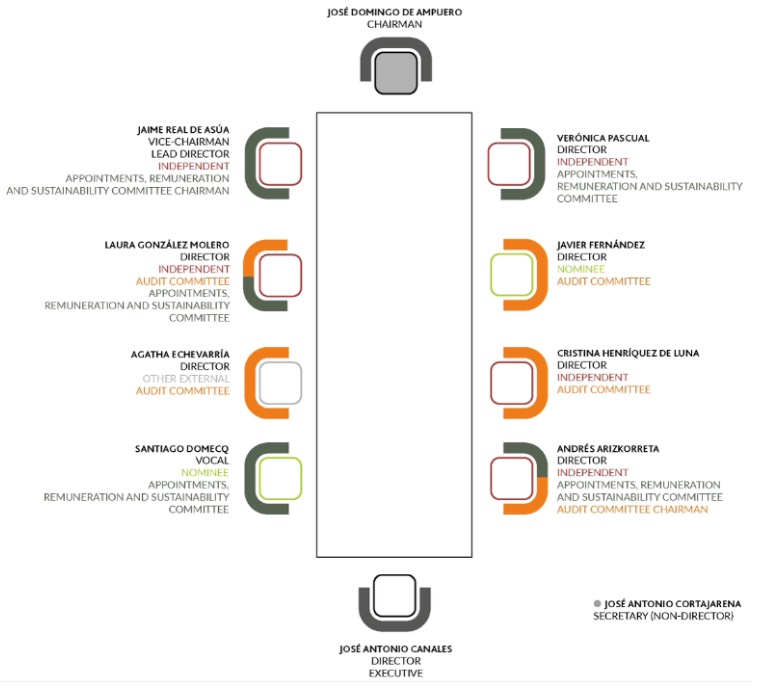
The Board of Directors consists of ten members, one of whom is an executive director, two are proprietary directors, two are classified as external directors, and five are independent directors. There is no direct representation of employees or other workers. The Board is composed of four women and six men.
Thus, the composition of Viscofan's Board of Directors complies with the recommendations for good governance of listed companies (hereinafter CBG) of the CNMV:
- The number of members of the Board of Directors is within the established limits of the range of between five (5) and fifteen (15) members indicated in CBG Recommendation 13 and is a number of directors in line with that of other companies comparable to Viscofan.
- Non-executive directors would continue to constitute the vast majority of the Board of Directors (9 out of 10).
- The number of independent directors reaches 50% of the total number of its members.
- The percentage of proprietary directors out of the total number of non-executive directors (2 out of 9) is in line with the proportion between the Company's capital represented by said directors and the rest of the capital.
- The percentage of female board members out of the total Board of Directors is 40%, reaching the target for female representation.
Changes in the composition of the Board of Directors in 2025 and its Committees
During 2025, there have been no changes in the composition of the Company's Board of Directors or its Committees:
| Name and Surname | Category | Position on the Board | Date of last appointment | Audit Committee | Appointments, Remuneration and Sustainability Committee | |
|
DON JOSÉ DOMINGO DE AMPUERO |
Other External | Chairman |
27/04/2023 |
|||
|
DON JOSÉ ANTONIO CANALES |
Executive | Chief Executive Officer |
29/04/2022 |
|||
|
DON JAIME REAL DE ASÚA |
Independent |
Deputy Chairman and Lead Director |
29/04/2022 |
Chairman | ||
|
DON ANDRÉS ARIZKORRETA |
Independent | Director |
29/04/2022 |
Chairman | Member | |
|
DOÑA LAURA GONZÁLEZ MOLERO |
Independent | Director |
29/04/2022 |
Member | Member | |
|
DOÑA AGATHA ECHEVARRÍA |
Other External | Director |
29/04/2022 |
Member | ||
|
DON SANTIAGO DOMECQ |
Proprietary | Director |
18/04/2024 |
Member | ||
|
DOÑA CRISTINA HENRÍQUEZ DE LUNA |
Independent | Director |
29/04/2022 |
Member | ||
|
DON JAVIER FERNÁNDEZ |
Proprietary | Director |
27/04/2023 |
Member | ||
|
DOÑA VERÓNICA PASCUAL |
Independent | Director |
18/04/2024 |
Member | ||
|
DON JOSÉ ANTONIO CORTAJARENA |
Secretary | Non-member | Secretary | Secretary | ||
| Percentage of independent directors |
50% |
|||||
| Percentage of women on the Board of Directors |
40% |
|||||
| Percentage of women over men |
67% |
|||||
The composition of the Board of Directors as at December 31, 2025 is as follows
To improve its functioning, the Board has established two committees: the Audit Committee and the Appointments, Remuneration and Sustainability Committee.
Audit Committee
It is composed of five members, all non-executive, with a majority of independent directors, appointed by the Board of Directors upon the proposal or prior report of the Appointments, Remuneration and Sustainability Committee, taking into account their knowledge, skills and experience in accounting, auditing or risk management, both financial and non-financial. Its chairman is independent director Andrés Arizkorreta.
The composition, functions, rules of organisation and operation, as well as the responsibilities attributed to the Committee are regulated in the Articles of Association, in the Regulations of the Board of Directors, and in the Regulations of the Committee itself.
It is responsible for reviewing the effectiveness of the Group's internal control and financial and non-financial risk management systems, overseeing the process of preparing and presenting the Group's sustainability information, and the Group's Regulatory Compliance System.
The functions of the Committee are detailed in section C.2.1 of the Annual Corporate Governance Report, which forms part of this Management Report.
Actions taken during the year:
The Audit Committee met 13 times during the year. It fulfilled all of its assigned functions in the areas at auditing financial statements, internal auditing, financial and non-financial reporting, internal control systems and risk management, the Ethics and Compliance Committee, the Information Security and Artificial Intelligence (Cybersecurity) Committee, and related-party transactions.
Specifically, within its functions on sustainability, the Committee has addressed aspects related to this matter such as the supervision of the Non-Financial Information Control System, regulatory and policy updates and, in particular, the monitoring of the preparation of this sustainability report, as well as the periodic review of the effectiveness of internal control systems and financial and non-financial risk management.
The actions carried out by the Committee in 2025 are detailed in section C.2.1 of the Annual Corporate Governance Report of this Management Report.
Appointments, Remuneration and Sustainability Committee
This Committee is composed of five non-executive directors appointed by the Board of Directors: four independent directors and one proprietary director. Its chairman is independent director Jaime Real de Asúa.
The composition, functions, rules of organisation and operation, as well as the responsibilities attributed to the Committee are regulated in the Articles of Association, in the Regulations of the Board of Directors, and in the Regulations of the Committee itself.
Among its functions, it promotes and supervises compliance with sustainability policies, ensuring their improvement and that the legitimate interests of stakeholders are taken into account, the establishment of goals and their monitoring.
Additionally, the functions of the Committee are detailed in section C.2.1 of the Annual Corporate Governance Report of this Management Report.
Actions taken during the year:
The Appointments, Remuneration and Sustainability Committee has met 9 times in 2025.
The main issues addressed and analyzed by the Committee during 2025, which have shaped its main areas of supervision, have included, among others, Corporate Governance issues and the composition of the Board, evaluation of the Board of Directors and Chief Executive, succession plans, updating of the organisational structure, the governance model and the governing bodies of Group subsidiaries, and remuneration policy.
In particular, within its functions on sustainability, the Commission has monitored the current sustainability strategy and indicators, the proposal for the New Sustainability Action Plan for the period 2026-2030, reviewed the exercise of its functions in relation to the consolidated non-financial information statement and sustainability information for 2024, and the reporting framework and preparation of the report for 2025.
The actions carried out by the Committee in 2025 are detailed in section C.2.1 of the Annual Corporate Governance Report of this Management Report.
Selection of directors
The Viscofan Group has a Diversity Policy in the composition of the Board of Directors and the selection of Directors, the update of which was approved by the Board itself in December 2024.
This Policy aims to ensure that proposals for the appointment or reappointment of directors are based on a prior analysis of the skills required by the Board of Directors and to promote the diversity of knowledge, experience, age and gender needed on the Board at any given time, taking into account the vacancies to be filled and the structure and composition of the Board.
This policy establishes the principle of diversity. Based on this principle, the selection of board members must be guided by the aim of achieving a diverse and balanced Board of Directors, one that contributes different perspectives to its internal discussions, thereby enriching decision-making. To this end, in the selection of board member candidates, preference will be given to those whose appointment contributes to increasing the diversity of knowledge, skills, experience, age, and gender, among other factors. The selection process must avoid implicit biases that could lead to any discrimination, and in particular, the selection of female board members is actively promoted. Therefore, when the Appointments, Remuneration, and Sustainability Committee or the Board itself, as the case may be, has been required to propose the appointment or reappointment of board members, without prejudice to respecting the competency matrix, the inclusion of candidates who contribute to incorporating board members of the underrepresented gender is actively sought. Furthermore, when faced with two similar professional profiles, in appropriate terms of comparison, the female candidate will be chosen.
Experience, resumes and profiles of the members of the Board of Directors
The Board of Directors includes members with expertise in sustainability issues at the strategic level, as well as in risk management, sustainability reporting, and corporate conduct. Given the rapid evolution of this area in recent years, the Board's various committees have received regular updates on the latest sustainability trends and regulations and their impact on Viscofan. They have also received specific training from third parties.
The CVs and profiles of the Board members dated December 31, 2025, detailing their experience, and in particular some cases in our sector, can be found
in section C.1.3 of the Annual Corporate Governance Report, which forms part of this Management Report. They are also available on the Company's website, in the Corporate Governance section.
Performance of duties
To carry out its functions with the rigor and efficiency they require, the Company's Board of Directors prepares an annual meeting schedule and an annual work plan for both the Board itself and its various committees. This allows for better planning by the directors and facilitates their time and attendance at meetings. The necessary information is sent to the directors well in advance, including, where applicable, the minutes or reports of the Board's various committees.
Actions continue to be taken to ensure the participation of the directors, facilitating their dedication and attendance at meetings, providing them with tools to delve deeper into specific aspects of the activity and particular environment of the different production centers, and thus be able to better monitor the strategy of the Group and each of its companies.
In addition, the annual plan includes visits to some of the Group's production centers, and the participation of managers to allow for greater monitoring of the implementation of the Group's strategy and the management of each of its companies.
Throughout 2025 the Board met on 12 occasions, the Chairman attended 100% of the meetings and there was 100% attendance of members present at the meetings.
Also in 2025, the Lead Director, within his functions established by the Regulations of the Board of Directors, held 2 meetings with independent directors to hear their concerns, and was also available for dialogue with investors and shareholders who requested it.
Assessment
The Board of Directors carries out an annual evaluation of the quality and efficiency of operation, diversity and competences of the Board itself and of the Committees, which, under the coordination of the Chairman, is driven by the Appointments, Remuneration and Sustainability Committee.
Every three years, the Board of Directors is assisted in carrying out this evaluation by an external consultant, whose independence is verified by the Appointments, Remuneration and Sustainability Committee. In 2025, KPMG Asesores, S.L. was engaged as an independent external advisor to facilitate this evaluation, as three years had passed since the last external consultation.
Specifically, the 2025 evaluation was carried out, on the one hand, based on a questionnaire whose purpose is to obtain the particular vision -self-evaluation- of each board member regarding the main aspects that affect the effective functioning of the Board of Directors and Committees, as well as a personal interview with each board member.
The results of the evaluation are anonymous and are presented in a consolidated manner and are subject to debate both in the Appointments, Remuneration and Sustainability Committee and in the Audit Committee regarding their own evaluation, as well as in the Board of Directors after which it approves the action plan to correct the areas for improvement detected.
Remuneration. Integration of sustainability-related performance into incentive systems.
ESRS 2 GOV-3
Remuneration is a key component of corporate governance, incentivizing and guiding the implementation of commitments and actions within Viscofan. In this regard, the remuneration systems for Board members and employees are aligned with the strategy, and particularly with sustainability, given its importance as one of the four strategic pillars. Consequently, sustainability indicators are integrated into both short- and long-term incentives.
Article 24 of the Regulations of the Board of Directors and Article 7 of the Regulations of the Appointments, Remuneration and Sustainability Committee grant the Committee itself powers relating to the proposal or report, as the case may be, on the remuneration of the directors and the senior management of the Company and its Group.
The remuneration of the Board of Directors for 2025 is governed by the Directors' Remuneration Policy, approved at the General Meeting held on April 27, 2023, with a validity of three financial years (2024, 2025, and 2026), and which is available on the company's website in the Corporate Governance section. This policy establishes a remuneration system for directors (i) for their position as directors and (ii) for specifically executive or senior management functions.
The policy in force in 2025 links the Annual Variable Remuneration of the directors with the rating of executives, which in 2025 corresponds to the CEO, to the achievement of a combination of economic-financial objectives (for example, Sales, EBITDA, BDI, Cash Flow, debt ratios), operational objectives (for example, stock/sales ratio or efficiency ratios) and sustainability objectives (for example, reduction of emissions, water management, reduction of waste or reduction of accident rates), which in 2025 represent 10% of the theoretical potential being linked to accident rates and compliance with training plans in the Group.
This criterion has also been extended to the annual variable remuneration of Viscofan's management and staff.
The remuneration of the Board of Directors in 2025 was 3,126 thousand euros (6,718 thousand euros in 2024).
See details of the remuneration of the Board of Directors and Senior Management in note 22 of the Group's consolidated annual report.
Furthermore, the Annual General Shareholders' Meeting held in April 2025 approved a long-term incentive in shares and cash for executive directors, members of the management team, and other employees of the Viscofan Group for the 2025-2027 period. This plan
The plan establishes a cash payment and shares in the Company, taking into account the achievement of shareholder value creation and sustainability objectives. These objectives include reducing Scope 1 and 2 emissions (12.5%) and reducing accidents (also 12.5%), with these sustainability elements representing 25% of the long-term incentive. The plan's measurement period is three years, ending on December 31, 2027.
Senior Management (December 31, 2025)
This is the highest hierarchical level of the organisation that reports directly to the CEO, and consists of regional general directorates (EMEA, APAC, NAM and SAM) that group the operations located in the countries belonging to that geographical region, the general directorate of New Businesses, and the corporate service general directorates:
| ORGANISATIONAL CHART as at December 31, 2025 | |
| Person | Post |
| ANDRÉS DÍAZ | Managing Director for EMEA (Europe, Middle East and Africa) |
| GABRIEL LARREA | General Manager of NAM (North America) |
| JUAN NEGRI | Managing Director APAC (Asia Pacific) |
| LUIS BERTOLI | General Manager of SAM (South America) |
| OSCAR PONZ | General Manager of New Business |
| MARÍA CARMEN PEÑA | Chief Financial Officer |
| JESUS CALAVIA | Chief Operating Officer |
| IGNACIO GOÑI | Commercial Director |
| JOSÉ ÁNGEL ARRARÁS | General Manager of R&D and Quality |
| JOSÉ ANTONIO CORTAJARENA | Secretary of the Board of Directors and Legal Director |
| ARMANDO ARES | Director of Investor Relations, Communications and Sustainability |
| BEATRIZ SESMA | Human Resources Director |
| JOSÉ IGNACIO RECALDE | Director of Diversification and Technology |
| ALEJANDRO BERGAZ | Director of Internal Audit |
| DOMINGO GONZÁLEZ | Director of Strategy |
| BORJA LÓPEZ | Director of Digital Transformation |
During 2025, the remuneration received by key management staff amounted to 5,165 thousand euros (11,842 thousand euros in 2024).
This amount does not include the remuneration of the executive director, Mr. José Antonio Canales García, which is detailed in the Board's annual remuneration report that forms part of this management report.
Changes in senior management as a result of the new strategic plan
As a result of the new strategic plan Beat'30, effective January 1, 2026, Viscofan will implement the following changes in its senior management organisational chart:
- Gabriel Larrea, former CEO of North America, is appointed as Chief Supply Chain Officer (CSO) leading the management of the value chain which includes: purchasing, planning, sequencing, logistics, warehousing and customer service.
- Consequently, Guillermo Eguidazu, current CEO of Viscofan USA, is appointed as CEO of North America.
- Domingo González is appointed CEO of the Health division, which includes the businesses that were previously grouped under the concept of Nutra-medical-pharma, and the diversification area, a role that he will combine with his current position as Chief Strategy Officer.
- Óscar Ponz, former CEO of New Business, is appointed CEO of Pet treats, also assuming the role of Deputy CEO of EMEA.
Governance and sustainability management
As the top executive responsible for Viscofan's activities, the CEO is the primary executive responsible for sustainability and also leads the Sustainability Executive Committee made up of directors from different areas where sustainability is relevant.
This Committee is responsible for establishing, coordinating, and monitoring the long-term objectives, initiatives, and work plans it sets forth in the area of sustainability, particularly environmental sustainability. In 2025, this Committee met four times to monitor sustainability indicators and develop a new Sustainability Action Plan for the 2026-2030 period, among other things.
Viscofan has a Director of Sustainability, responsible for coordinating all sustainability matters across the Group, including strategy, goal setting, specific analysis of issues, risks and opportunities, sustainability reporting, and stakeholder engagement. This Director is also responsible for reporting to the Board of Directors and its various committees on sustainability matters within their purview.
During the year, the Board of Directors was informed once, the Appointments, Remuneration and Sustainability Committee three times, and the Audit Committee three times. Of particular note is the development of a new Sustainability Action Plan for the 2026-2030 period and the work involved in preparing and verifying this report. Information was also provided on significant sustainability-related incidents and risks.
Additionally, Viscofan has an executive sustainability subcommittee, made up of people from departments in areas where sustainability is relevant.
The management of the various material aspects of sustainability, in turn, falls under different areas:
- Environmental and safety aspects at the Group level fall under the responsibility of the Corporate Department of Operational Sustainability, which reports to the General Directorate of Operations and is in charge of coordinating and supervising this matter in all of the Group's production plants.
- The management of the specific social aspects of our own staff is assigned to the Corporate Human Resources Department.
- Regulatory Compliance to the Ethics and Regulatory Compliance Committee and to the Legal Department.
- Food Safety to the Quality Management and Regulatory Affairs Departments under the General Directorate of R&D and Quality.
- Customer relations are handled by the Sales Department.
- The relationship with suppliers to Supply Chain is dependent on the Operations Department.
Setting sustainability goals
Within all the areas encompassed by sustainability, setting targets related to impacts, risks, and opportunities is a key element of the Sustainability Action Plan. These targets are established by the Executive Sustainability Committee based on the material aspects identified and where Viscofan can make the greatest contribution.
Once established, these are reviewed and, after a report from the Appointments, Remuneration and Sustainability Committee, approved by the Board of Directors within the framework of the current Sustainability Action Plan.
Subsequently, their evolution is monitored quarterly in the Executive Sustainability Committee and the Appointments, Remuneration and Sustainability Committee, as well as the Board of Directors, are reported periodically.
Risk management and internal controls for the disclosure of sustainability information
ESRS 2 GOV-5
Viscofan has a sustainability information control system implemented with scope to all companies in the Viscofan Group and which has an impact on the processes and sub-processes related to sustainability information.
It is based on the policy of the internal control system for financial and non-financial information and requires that internal control systems provide reasonable assurance of the reliability of financial and non-financial information.
This system is based on best practices and international standards, taking as its basis the one established in the COSO report, as well as compliance with legal requirements.
The system consists of five components:
- The control environment
- Information risk assessment
- Control activities
- Information and communication
- Review and monitoring
Information risks are associated with processes and sub-processes, which cover material non-financial information based on the Viscofan Group's Sustainability Action Plan.
- Environment: energy consumption, Scope 1 and 2 emissions, water collection, waste disposal.
- People: Breakdown of average staff by categories, remuneration, wage gap, and training.
- Security: information that supports the calculation of the indicators for this subject.
Risk identification is coordinated by the Corporate Sustainability Department in collaboration with those responsible for information at
Human Resources, Environment and Safety, as well as the Internal Audit Department. In each process and subprocess detailed above, the Group identifies the risks that may materialize by analyzing the following requirements:
Description of existing control objectives to meet the business objectives defined by the Company, and to ensure the reliability of sustainability information.
Possibility of occurrence of the risk of error with the following criteria:
- Validity: all transactions generated in the period are valid.
- Integrity: all transactions are recorded correctly.
- Record keeping: all transactions are accurately recorded.
- Cut-off: all recorded transactions represent events that occur during the period in question; transactions are recorded in the corresponding period.
The risks identified based on these criteria form the non-financial reporting risk matrix. Of these, the most relevant are those that directly affect the Group's sustainability objectives, such as GHG emissions, waste disposal, water catchment, accident rates, and women in management positions. The mitigation strategy varies depending on the risk; however, subsidiary-level controls have been implemented primarily to ensure the accurate recording and review of information reported to corporate headquarters for subsequent consolidation.
The non-financial information control system has been integrated together with the financial information control system in SAP GRC, a unique environment that allows for the automation and computerization of information process assurance.
As reported in Articles 6 and 8 of the Audit Committee Regulations, one of the main functions of the Committee is to supervise and evaluate the process of preparation, presentation and integrity of non-financial information relating to the Company and its consolidated Group, reviewing the correct design of internal control systems for information, and compliance with regulatory requirements.
Reporting directly to the Audit Committee is the Viscofan Group's Internal Audit Department, whose scope of work is to determine whether the Viscofan Group's risk management and control processes, designed and operated by Management, are adequate and function in a way that ensures, among other things, that information is accurate and available in a timely manner.
Throughout the year, the implementation and monitoring of the controls was continuously tracked. In addition, Internal Audit reviewed the controls related to human resources and environmental indicators, proposing improvements and corrective actions.
Since this report involves reporting additional information beyond that contemplated in the initial definition of the SCIINF, Viscofan plans to standardize the process of reporting new information in the coming years for the subsequent analysis of processes and subprocesses, identification of information risks, and their inclusion in the implemented SCIINF.