
1.1.3. Strategy
Our business model outline
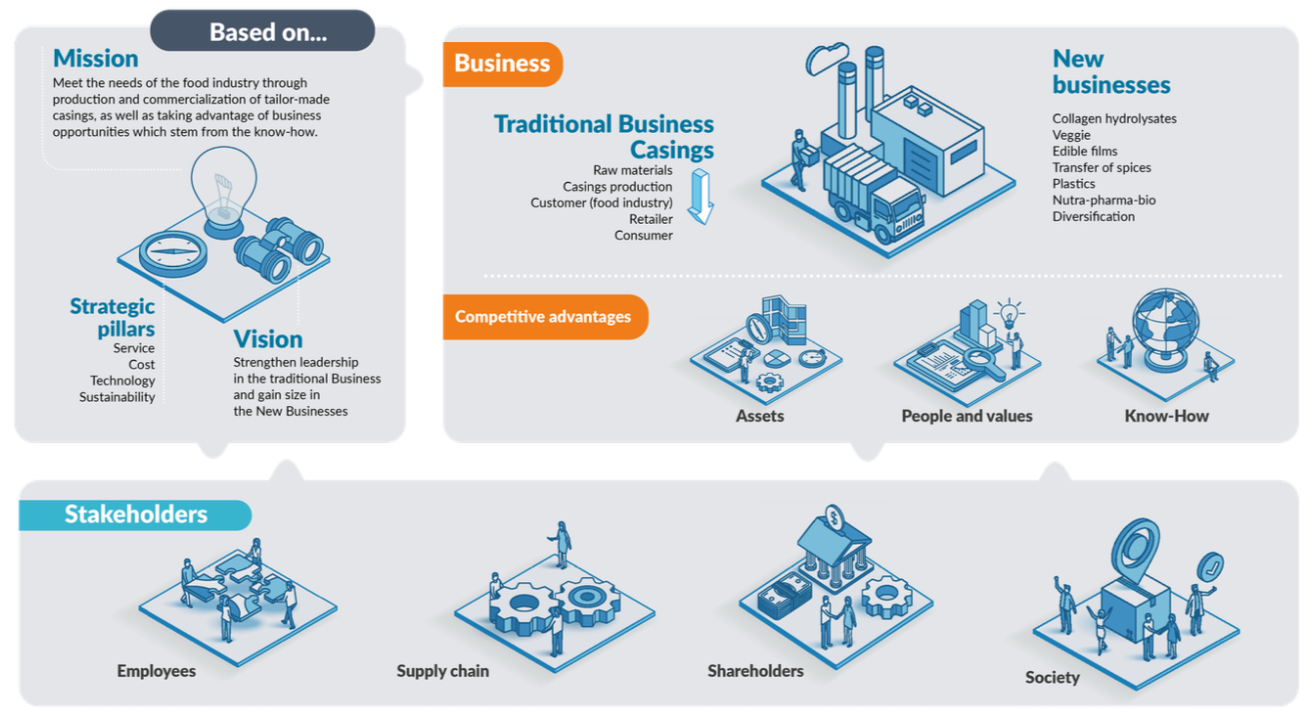
Strategy, business model and value chain
ESRS 2 SBM-1
Our purpose and mission
Purpose
Since 2022, Viscofan has had a purpose that goes beyond traditional boundaries: “Reshaping food and wellbeing. For many, for long,” seeking to help facilitate access to food and nutrition worldwide, as well as improve people's well-being and health.
“Reshaping food and wellbeing” means that our technology and global presence allow us to shape a better world. We contribute to improving access to food worldwide and can also help improve human wellbeing through nutrition and our expertise.
“For many” means that if there is one thing that characterizes us, it is that we have always wanted to be relevant, to generate impact, that is why our scope of action is the world, “for many”, the more people who can enjoy our products, services or solutions, the better for our purpose.
“For long” means that we generate a lasting impact, a project for the future, a project intended to be permanent, “for a long time.” It is an impact for everyone, for life, for the well-being of all. This is our sustainable proposal.
Mission
To meet the needs of the food industry through the production and marketing of custom-made casings, as well as to take advantage of the business opportunities derived from the know-how achieved through the production and marketing of collagen-based products for food use.
New Sustainability Strategy and Action Plan
Following the completion of the Beyond25 strategic plan, Viscofan is embarking on a new phase of growth with the Beat'30 plan for the period 2026-2030. This plan reflects our ambition to surpass our historical growth and the passion of our team, with four strategic pillars:
- Definition and expansion of markets, reorganized into three divisions: Food: Ingredients & Packaging, Pet Treats and Health.
- Boosting sales growth, consolidating positions, and exploring new opportunities.
- Competitive improvement through investments in resources, capacity and processes, placing the customer at the center of the value chain.
- Internal development and simplification, empowering talent and accelerating digital transformation.
Furthermore, the Board of Directors has approved a new Sustainability Action Plan for the period 2026-2030, based on the identification of incidents, risks and opportunities through materiality assessment, reinforcing our commitment to long-term value creation, and which establishes actions and goals regarding climate change, pollution, circular economy and use of resources, own staff, consumers and end users, and business conduct.
Strategy
This report corresponds to the last year of the Beyond25 strategic period. To facilitate consistency between financial and sustainability information, the information and description of the business model are broken down according to said plan.
In this strategic plan, Viscofan maintains its ambition to transform the company, as in previous strategic plans. To this end, Viscofan expanded its business scope with a new purpose: “Reshaping food and wellbeing. For many, for long.”
This objective has meant redefining our business model with a market approach that combines our major competitive advantages: the combination of the largest global geographical presence, both productive and commercial, with a broad and unique product catalog, developed with proprietary technology and know-how, which continue to evolve thanks to a culture of excellence and continuous
improvement, based on solid values and ethical principles shared by a highly committed human team.
This strategic plan has featured four major management regions to provide greater flexibility and proximity to the market: Europe, Middle East and Africa (EMEA), North America (NAM), Asia Pacific (APAC) and South America (SAM), complemented by a cross-functional “New Business” division.
Furthermore, the strategy has focused on a market approach that distinguishes between the Traditional Business (which includes cellulose, collagen and fibrous plastics) where Viscofan has a privileged position to continue taking advantage of growth opportunities; and the New Businesses (which includes tubular plastics, packaging and third parties, edible casings, functional solutions, nutra-medical-pharma products, as well as diversification activity), where Viscofan wants to leverage know-how as a catalyst for innovations to expand into new markets with attractive growth trends in the food, wellness and health sector.
The strategy is based on four cross-cutting pillars: service, cost, technology and sustainability, with the ambition to lead the market in each of them.
Likewise, to drive change, Viscofan is leveraging Digitalization and People, with people management and digital transformation initiatives that help make processes more efficient, boost career development and a better work-life balance.
In accordance with this strategic plan, Viscofan has a Sustainability Action Plan 2022-2025 with specific projects to combat climate change, measures to reduce water consumption, and improvements to transform our processes into a more circular economy and reinforce our commitments to the Sustainable Development Goals of the United Nations' 2030 Agenda.
Viscofan has six sustainability commintmens. While no specific target has been set for these, two of them allow us to make a contribution through our products and services:
SDG 2. Zero Hunger: belonging to the food market implies a great responsibility: to offer millions of people worldwide access to basic nutrition. As a world leader in custom casings, the Viscofan Group contributes to the development of products that help prevent food waste, invests in R&D&I that enables more efficient and sustainable sausage manufacturing processes, seeks to collaborate with NGOs whose core business is based on reducing hunger, and seeks to develop specific products that combat malnutrition.
SDG 3. Good Health and Well-being. Viscofan is committed to transforming the extensive knowledge developed in the processing, use, and transformation of raw materials, especially collagen, into products and solutions that contribute to improving people's health and well-being. Collagen is the most abundant protein in the human and animal body, but it is also a unique and versatile material, and therefore finds applications in diverse fields beneficial to people, such as regenerative medicine, nutrition, health, and life sciences.
The main strategic projects carried out in 2025 are detailed below:
- Expanding capacity in collagen casings given the positive growth prospects in this product family
- Installation of production capacity for plastic bags for meat products at the San Luis Potosí plant in Mexico
- Investments earmarked for environmental and safety projects, notably the investment in a new gas scrubber in Cáseda
- Acquisition of 51% of Pet Mania Comércio Internacional Ltda, a Brazilian company dedicated to the production and marketing of “pet treats” (animal-based treats for pets), for a cash value of 34 million Brazilian reais
Additionally, the strategy, the resilience of the business model, and the specific action measures have been detailed in each ESRS.
Our markets
With the Beyond25 strategic plan, commercial and operational strategies have been reoriented, distinguishing between sales of what has been termed Traditional Business (82.6% of net revenue), which includes casings based on collagen, cellulose, and fibrous technology, and sales of New Business (12.8% of net revenue), which includes plastic casings and the remaining products and services. These two divisions are not identified within the categories of the ESRS sectors and are therefore considered "Other."
Additionally, to a lesser extent, 4.7% of the Group's net revenue corresponds to energy sales. These include cogeneration activity, which for the Viscofan Group consists of selling electricity (€49.7 million in 2025) to third parties. This electricity is not used by the Group in its core business production process and is included in Annexes 1 and 2 of the EU Taxonomy Regulation as an eligible activity for climate change mitigation and adaptation objectives. The remaining energy sales correspond to revenue from the sale of electricity generated at the Zacapu (Mexico) facilities, an activity not eligible under the taxonomy.
Viscofan has not availed itself of the exemption from disclosure of information referred to in Article 18(1)(a) of Directive 2013/34/EU, on the breakdown of net turnover by categories of activities, as well as by geographical markets, insofar as those categories and markets differ from each other in a substantial way, taking into account the way in which the sale of products and the provision of services are organized.
Therefore, the revenues obtained by the Viscofan Group, which can be grouped by nature into Traditional Business, New Businesses, and Energy, are significant for Viscofan as established in point AR 13 of ESRS 2 and represent 100% of net revenue. Their breakdown is as follows:
| In thousands of euros | 2025 | 2024 | |
| Traditional Business | 1,033,697 | 996,610 | |
| New Businesses | 159,728 | 147,326 | |
| Other energy revenues | 58,558 | 60,058 | |
| Revenue | 1,251,983 | 1,203,994 |
Although from a management information point of view, the activity is considered a single segment, being mostly the sale of casings as stated in Note 18 of the Consolidated Report according to IFRS 8.
Within the framework of the Sustainability Action Plan, there are no specific objectives related to sustainability in terms of significant product and service groups, customer categories, geographical areas or stakeholder relationships.
Traditional Business - Casings
In sausage production, food companies can use animal casings, or casings made primarily from natural materials. These are soft, cylindrical containers that give sausages and other cured meats their characteristic shape and are of great importance to our customers in their pursuit of greater efficiency, increased production speed, reduced waste, and guaranteed quality.
The manufacture of casings for meat products is an industrial process of a physical-chemical nature that converts the raw material into a continuous tubular structure.
The process begins with the preparation of the raw material, which undergoes specific treatments to denature it and give it the properties necessary for its subsequent shaping. This stage involves interactions with chemical substances that modify its structure and functionality.
Next, extrusion takes place, whereby the transformed material is formed into a continuous tube called the casing. This tube then undergoes washing and neutralization phases to remove any traces of agents used in the processing, ensuring product safety and compliance with food regulations.
The chemicals used in these stages, while essential to ensuring the product's functional properties, carry a potential environmental impact. Emissions into the atmosphere and discharges into water can be generated during the process, requiring treatment and control systems to minimize their effect on the environment.
The casings are characterized by their ease of use and appearance, which contrasts with the high technological component that resides in the production process and which has only been developed by a small number of companies worldwide.
In particular, collagen casings offer specific characteristics and benefits for the meat industry compared to traditional sausage production methods using animal casings.
Among the advantages of collagen casings are their uniformity and consistency, which allows for more efficient and standardized production with better use of raw materials. They are also easier to handle and do not require any preparation before the stuffing process, unlike animal casings.
Additionally, since food safety is a key aspect of food production, collagen casings are manufactured under highly controlled and standardized conditions, reducing the possibility of contamination with pathogenic microorganisms and resulting in a longer and more stable shelf life. They do not require pre-cleaning, eliminating the risk of cross-contamination that could occur during that process.
Finally, the production of collagen casings, and specifically at Viscofan's production plants, is subject to rigorous health and quality regulations. See details in the ESRS S4 Consumers and End Users section.
There are different types of casings depending on the main raw material used.
- Cellulose wraps: the main raw material is cellulose, a linear polymer composed of glucose units found in the cell walls of plants, wood, and natural fibers, usually combined with other substances such as lignin, hemicelluloses, and other components. To produce wraps, it is necessary to break the cellulose chain to obtain a polymer of the appropriate length for extrusion into a wrap shape and with very specific elastic properties. This process requires high-purity cellulose, also referred to by our approved suppliers as "premium cellulose" or "special cellulose."
- Collagen casings: Collagen is a very common, long fibrous protein with remarkable chemical and mechanical properties. Besides its application in sausage casings, it has uses in the fields of biomedicine, cosmetics, and the food industry, being a basic material used in the extensive gelatin industry. The corium, or inner layer of bovine skin, which is very rich in collagen, is primarily used for the production of collagen casings.
- Fibrous casings: a combination of cellulose and abaca paper, the latter obtained from a herbaceous plant called Musa textilis. The paper produced from its fibers has high mechanical and moisture resistance and is used by Viscofan for the production of fibrous casings. Abaca fiber is also used by other industries to produce high-quality paper and non-woven textiles for various uses such as tea bags, banknotes, and filters.
- Plastic wraps, films and bags: these are obtained through the treatment of different plastic polymers widely used in different industries; the most commonly used polymers are polyethylene, polypropylene and polyamides.
Additionally, Viscofan also uses the following inputs for the production process:
- Chemicals used as auxiliaries in the production of different types of casings, the most relevant being caustic soda, sulfur compounds and glycerin.
- Water: In its production plants, Viscofan requires the collection of water for different phases of the process such as the washing of casings, cooling, steam production, and humidification of casings, mainly.
- Energy: Casing production is a continuous and energy-intensive process, primarily due to the drying phase. Based on current technology, the most efficient energy generation method for casing production is through natural gas combustion. This is the main energy input used by Viscofan in its plants and is supplemented by electricity consumption.
To ensure the supply of key raw materials, Viscofan works with a number of certified suppliers, with strong and long-lasting relationships.
Additionally, within the procurement strategy, the search for diversification of suppliers is key, both by type of material and geographically.
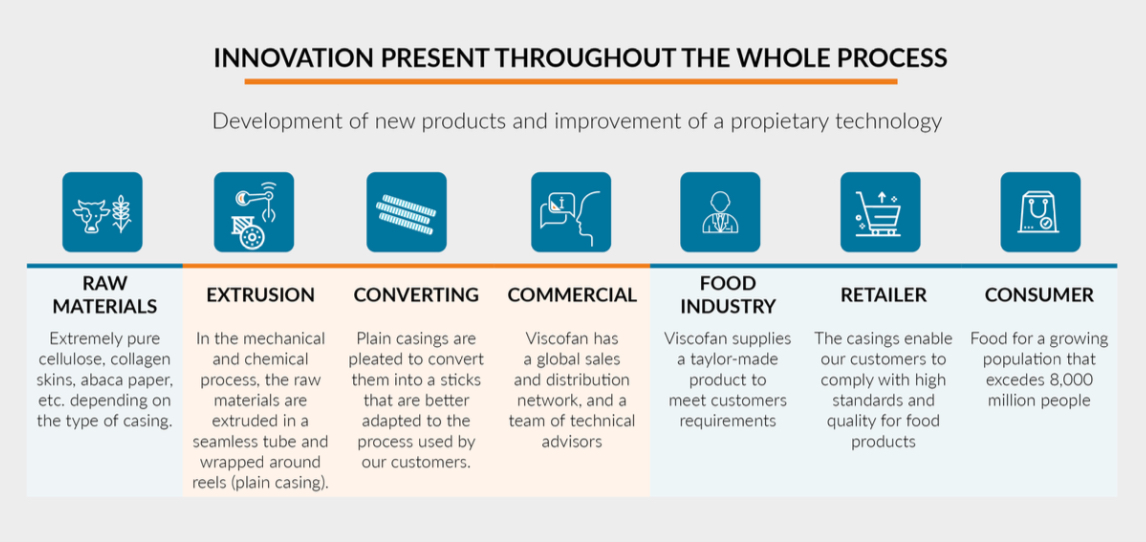
The food industry, and particularly sausage production, increasingly demands higher-performing, more sustainable products at a highly competitive cost. Meeting this demand entails a significant technological and development challenge, which Viscofan successfully addresses as the largest producer of casings, being the only company in the industry to provide solutions across all major casing categories.
Casings are an essential food component, providing protein access to millions of consumers. Viscofan sells them directly or through distributors to the meat industry for sausage production. Viscofan has the largest production presence in the industry and sells its products in over 100 countries, transporting them primarily by truck or ship, depending on logistical needs.
Sausages are generally sold by the meat industry to supermarkets and restaurants, although, for the most part, the casings with which they have been produced are not perceived by the consumer, especially in the case of cellulose and fibrous casings, which are peeled by meat companies in most cases before sale.
Consumers are increasingly conscious when making purchasing decisions, demanding greater transparency regarding the environmental and social impact of products, functional performance, safety ratings, and production traceability throughout the entire value chain.
Being part of the food market carries a great responsibility: providing millions of people worldwide with access to basic nutrition. This growing population has evolving expectations regarding taste, formulation, and the overall consumer experience, demanding the highest guarantees of quality and food safety.
The custom casings market has a historical growth rate of around 2-4% in volume thanks to solid fundamentals based on:
| Category | Trend |
| Population growth | An average annual growth rate of 1%, with emerging areas being the driving force behind this expansion. |
| Eating habits | Higher per capita demand for meat is being driven by emerging markets, thanks to the increased purchasing power of the middle class, globalization of eating habits, and urban population growth. In developed areas, nutritional trends are shifting towards a preference for chicken protein, seeking greater convenience and a product with higher nutritional quality and food safety. |
| Greater sophistication of meat processors | Increased focus on productivity, food safety and hygiene, and the development of new products is driving the replacement of animal casings with custom-made casings (mainly collagen), as well as the development of new products. |
In 2025, the casing market is estimated to have grown by 4% in volume, at the high end of its growth rate, with collagen casings standing out, driven by the trend of replacing animal casings.
Thus, by 2025 the casings and casings market is estimated to be worth €5.1 billion. To meet the needs of sausage making, meat processors must choose from the various market options, either with animal casings or, if they prefer, custom-made casings, which in turn can be produced with different materials depending on the desired production and product characteristics, combining a better range of casings with production savings.
New Business
The know-how and experience acquired in diversifying the use of collagen as an ingredient in various applications unrelated to the world of casings, our continuous dialogue with the market allowing us to identify needs not always associated with casings, together with the experience we have obtained in our production processes have led to product solutions framed within the New Business division.
With this division, Viscofan goes beyond the traditional casing market and enters a market with a potential of over €5 billion, in which Viscofan has a small size, but it is undoubtedly a great opportunity for its products and innovations that seek to provide solutions to trends in the food and health sectors that are becoming increasingly relevant.
The main growth catalysts identified are:
| Category | Trend |
| Population | • Growing population • Population aging |
| Eating habits |
• Increased protein intake • Vegan and vegetarian trend • Convenience and variety • Healthy and sustainable food |
| Food industry | • Circular Economy |
| Health |
• Seeking well-being and personal care • Development of biomedicine |
Diversification
Within the New Business division, Viscofan has a strategic unit focused on diversification that actively pursues and develops cutting-edge growth and innovation opportunities in materials and other businesses beyond casings.
These opportunities are explored and developed directly by internal teams, and through collaboration agreements with third parties that excel in specific fields (technological, industrial, medical, etc.).
Activities related to food, health and sustainability constitute the fundamental pillars of diversification activities.
Of these, Viscofan's extensive knowledge in the processing, use, and transformation of biopolymeric raw materials represents an opportunity for innovation and, therefore, growth. A good example is the new solutions based on technological knowledge of collagen.
Collagen is the most abundant protein in the human and animal body, but it is also a unique and versatile material, and therefore finds applications in various areas of interest to human health such as regenerative medicine, nutrition, health, life sciences, etc.
Viscofan applies extraction technologies and methods to process bovine skin collagen for the development and industrial-scale production of new collagen biomatrices in the medical, nutraceutical, and food fields.
In addition, Viscofan is exploring new business avenues by acquiring minority stakes in several disruptive startups, providing funding and, in some cases, expertise, resources, and market access to facilitate their growth. The companies in which Viscofan holds stakes are: ODS Protein, Feltwood, MOA Biotech, Insekt Label Biotech, Cocoon Bioscience, and Inmedical Therapeutics.
Viscofan also participates in partnerships where it shares knowledge to develop innovative solutions in different fields. Of particular note is the TriAnkle project, a consortium of companies led by Viscofan and funded by the EU to manufacture customized 3D-printed implants.
collagen and gelatin-based projects for the regeneration of injured tendons and cartilage; the European consortium Accelerating Research and Innovation for Advanced Therapies (ARDAT) for the development of advanced therapy medicinal products; and the European consortium projects "Brave" on cardiac regeneration and "Unloc" on 3D solutions for the field of "Organ on a Chip".
Our competitive advantages
Viscofan's progress is understood from the achievement of sustainable competitive advantages, which are the result of the work and commitment of an exceptional human team that has been offering the best of each one for 50 years, to make Viscofan the leading company in the casing sector and expand its frontiers into new businesses in the areas of food and wellness.
People and values
People are the differentiating value on which Viscofan's future is built, a team made up of an average workforce of 5,721 people, of which 2,881 are in the EMEA region, 1,334 in North America, 978 in South America and 529 in Asia Pacific.
A team distributed around the world but supported by shared values:
- We are decisive: we seek excellence in quality, we work with a customer and results orientation, we are committed to our work and we carry it out in an agile manner.
- We work as a team: we approach our work with passion, valuing expertise, agility, and excellence. We enjoy collaborating with a shared purpose.
- We are pioneers: we seek new ways of doing things, taking the risk of going further, diversifying, innovating and contributing to a better future.
- We enjoy our work: we are enthusiastic about life, eager to do things, make decisions, and seize opportunities. We value responsibility and commitment to our work.
Concurrently, these values are based on non-marketable ethical principles (integrity, loyalty, respect and human rights).
The Viscofan Group understands that creating long-term sustainable value for all stakeholders can only be achieved through ethical behaviour that fosters a culture of best practices in social responsibility within the Group and contributes to improving people's well-being through the economic, environmental, and social development of the communities in which the Viscofan Group operates.
R&D and Innovation. Technology and Know-how
Viscofan's position in a constantly evolving and highly competitive global market is linked to its ongoing, cutting-edge research, development, and innovation (R&D&I) efforts, both in technology and product development. This philosophy alone allows the company to maintain its leadership in global innovations within the casing industry, driving and developing new businesses and ultimately benefiting its various stakeholders.
This activity is made possible by a network and culture of innovation that extends throughout the organization. The corporate R&D center in Spain coordinates, directs, and supports the specific R&D activities and work of each production plant and manages the coordination of multidisciplinary work teams. The corporate center aims to share the
best practices, technological knowledge and ideas among the different production centers.
We must consider the constant innovation demanded by the globalized world we live in. Our products must be compatible with and adapt to the dietary habits and customs of millions of consumers worldwide, their preferences, and how these evolve over time. Viscofan supports its growth as a company by developing its innovative capacity to access the best technologies available on the market, assimilate and improve them, and develop its own technologies that provide competitive advantages. This is all while driving continuous improvement, seeking greater efficiency and sustainability in the enhancement of processes and products.
In this sense, Viscofan adopts a proactive approach in the search for sustainable solutions at the technology and product level, promoting relevant aspects such as the circular economy, the search for energy efficiency, the reduction of GHG emissions, pollutants and the lower need for water use.
Advances in digitalization present a new opportunity for innovation that Viscofan intends to leverage to lead the industry's digital transformation. In collaboration with third parties, Viscofan's Digital Transformation team is working to implement the solutions offered by new IT technologies in our operations. We aim to improve product quality, obtain the best possible information to enhance our production processes, implement predictive maintenance using machine vision solutions, develop technological solutions for digitizing material handling within our facilities, and develop and implement an intelligent management system.
Innovation is an ongoing process with strategic technological and product development projects across all casing families (cellulose, fibrous, collagen, plastics, and plant-based) and their end-product applications, including other diversified products. Our innovation drives innovation in the food sector, enabling the development of applications that provide Viscofan with the product range necessary to strengthen its presence in the global market.
Action plans
Therefore, the main current projects underway are primarily focused on the following areas:
- Development of new products in accordance with the target markets defined in the expansion plan, as well as those required by our clients, and also next generation executions, designed and directed to offer tubular alternatives with differential performance and features.
- Development of casings and films capable of transferring functionalities to the product being processed in them, gaining in efficiency and thus avoiding food waste.
- Development of productive alternatives and technological solutions that entail a radical leap that, through modernization, rationalization and simplification, allow us to increase the added value or reduce the production costs of packaging, as well as significantly improve efficiency levels, thus enhancing the competitiveness of our products and processes.
- Drive to find technological solutions that improve the sustainability of our operations in terms of energy and water efficiency, efficiency in the use of raw materials, reduction of waste and pollution, and improvements in safety.
- Research aimed at expanding the range of suitable materials for the manufacture of packaging and their performance, also taking into account sustainability criteria such as their biodegradable or recyclable nature.
- Technological support for the improvement of existing products and processes, as well as for the international expansion of the company; all in accordance with Viscofan's technological and quality standards and current regulations, as well as for the optimization of production costs.
- Digitalization: Within the Digital Transformation Department, Viscofan has an Advanced Data Analytics area, among whose actions in the year it is worth highlighting work on demand prediction, energy efficiency and the development of predictive models of quality parameters.
Our assets. Wide range of products
Viscofan is the only company in the packaging industry that has the main technologies available, and offers the customer a wide portfolio of packaging that allows them to choose the one that best suits their needs in a context of globalization in eating habits and the need to adapt to changing consumer demands where the focus on health, convenience, experience, variety and awareness of sustainability are more relevant.
Our casings facilitate access to basic food for a growing global population, especially in emerging areas where consumption habits increasingly demand more protein, whether of animal or plant origin.
Our extensive product portfolio in packaging, the largest in the industry, allows the customer to choose the packaging that best suits their needs, while with the Beyond25 vision and Strategic Plan we expand boundaries with innovative New Business solutions that go beyond traditional packaging.
During the year in the traditional business, Viscofan has launched three edible collagen products called "thin", "thin tender", and "profry" that aim to improve the consumer experience, and also optimize the industrial processes of sausage manufacturing compared to the intestine alternative.
Among the new businesses, the installation of machinery for the production of special bags for meat products stands out. Also noteworthy is the addition of pet treats (animal-based treats for pets) to this division's product range following the acquisition of 51% of Pet Mania Comércio Internacional Ltda.
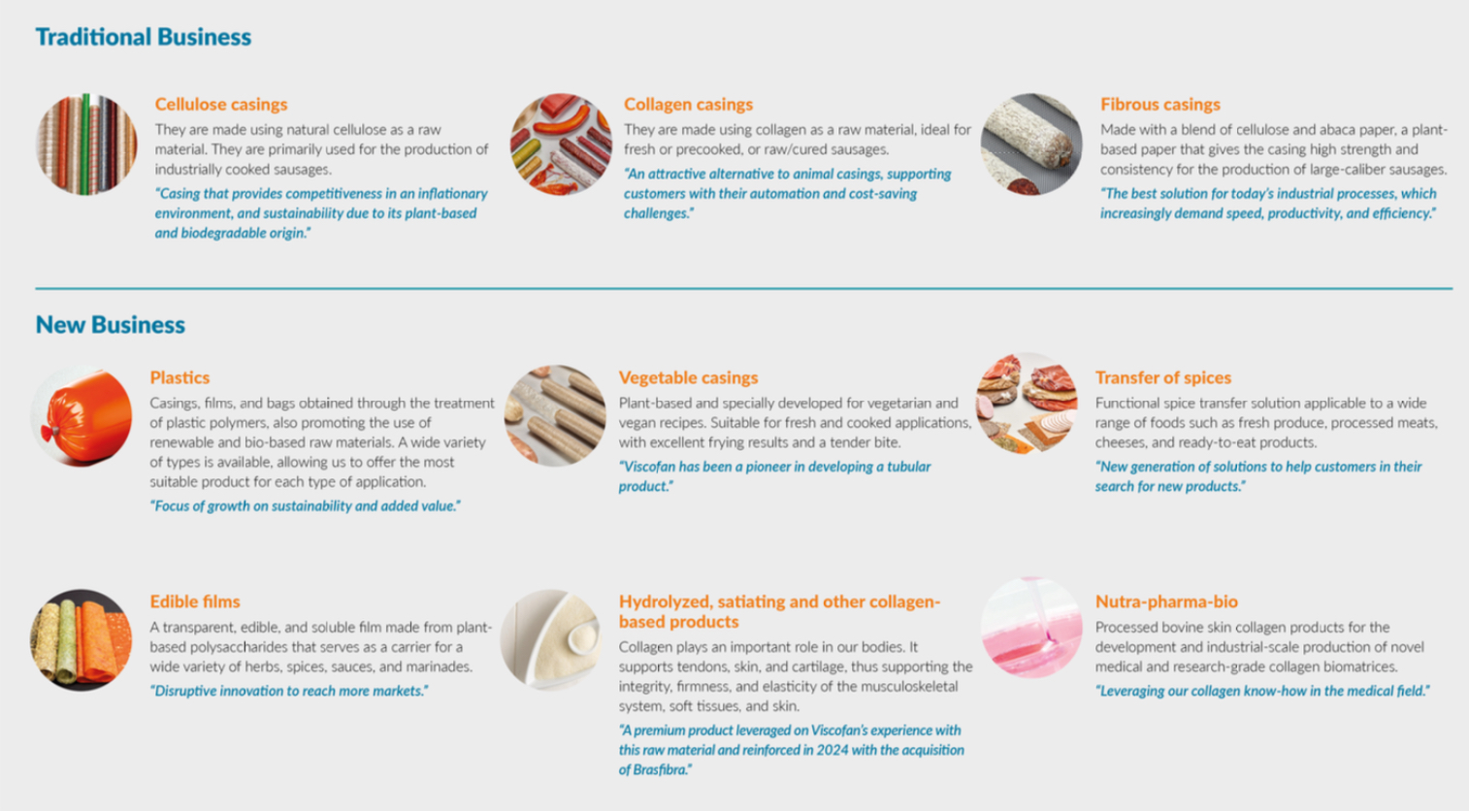
For more information about Viscofan products, please see the Products and Markets section of the corporate website.
Our assets. Geographic presence
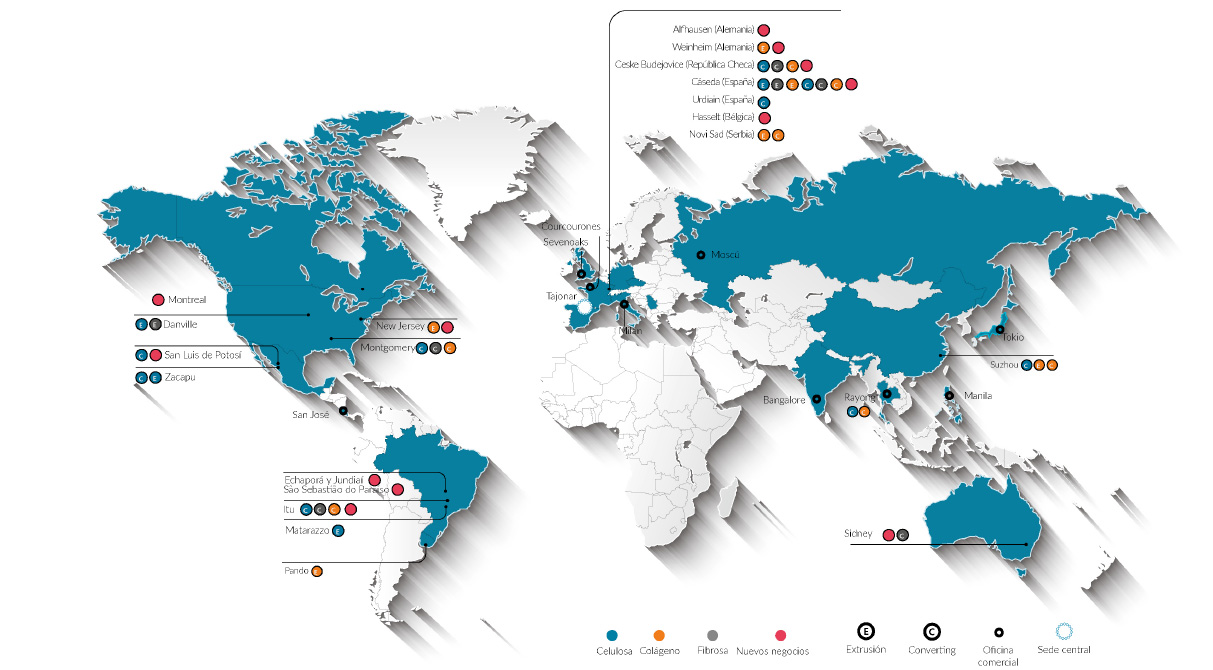
The packaging market is global. Our customers are located in over 100 countries worldwide, and providing a fast and tailored response to their needs is often a key factor in their purchasing decision. To enhance this responsiveness, we have the largest production and sales network in the market, with our own facilities in 21 countries.
Geographic expansion is a constant for the Viscofan Group. In 2025, Viscofan acquired Pet Mania, a company with pet treat production facilities in Brazil, and in 2024, also in Brazil, Viscofan acquired Brasfibra and Master Couros, companies with production facilities for collagen-based products.
In 2024, the construction and commissioning of a collagen and cellulose casing converting plant in Thailand was completed with the aim of improving service in Southeast Asia, one of the casing markets with the best growth prospects.
In addition, between 2021 and 2023, Viscofan Japan GK was established with the aim of having its own commercial presence in Japan, one of the world's leading casing markets, and the opening of representative offices in Italy and the Philippines with the aim of improving service in these important markets and enhancing learning about them.
Value generated and distributed
ESRS 2 SBM-1 paragraph 42.b)
The following describes the results in terms of benefits from Viscofan's products and services and activity for key stakeholder groups.
Customers and end consumer
With our packaging, we help provide access to basic food for the world's population. Our clients achieve greater production efficiency by adhering to strict quality and food safety controls, and ensuring clear labeling. Listening to our clients is key to meeting their needs, allowing us to offer the most suitable product and drive a more sustainable industry.
In addition to our contribution to the food industry, we generate value for society by promoting human well-being through nutrition and responsible innovation. Our specialized knowledge allows us to develop solutions that improve quality of life, primarily through collagen-based products for food and health applications.
These products not only provide functional benefits, but are also aligned with SDG 3: Good Health and Well-being, by offering ingredients that contribute to a balanced diet and health care.
Suppliers of raw materials and services
Viscofan is globally committed to its suppliers, establishing relationships based on respect, trust, and the quality of products and services. On this foundation, it works closely with its suppliers to understand their specific needs and challenges. This collaboration enables the development of tailored solutions that benefit both parties, creating lasting and successful business relationships.
Furthermore, based on its commercial and trusting relationship with suppliers, it seeks to ensure that all companies in the Group pay invoices on time and in full, regardless of their size and category.
Employees
We guarantee decent working conditions for all employees, ensuring non-discrimination in hiring. Viscofan also remains committed to ongoing job creation.
We support the promotion and professional development of our teams, especially our younger employees. We keep them informed about opportunities and processes within the company so they can pursue new challenges and goals.
We guarantee freedom of association and collective bargaining.
We create a stable work environment, supporting full-time and permanent contracts, in a climate of respect and non-discrimination.
We promote youth employment through recruitment and internship programs.
We have occupational health and safety management systems in all of the company's plants.
Shareholders
Throughout its various strategic plans, the Viscofan Group has consolidated a solid and flexible business model capable of generating recurring cash flows. This financial strength allows it to undertake investment projects aimed at reinforcing value creation, which is shared with shareholders through sustainable returns, while maintaining a robust balance sheet structure.
Therefore, the Board of Directors has agreed to propose a total dividend of €3.25 per share from 2025 results, an increase of 3.5% compared to the previous year. (See note 12.6 of the consolidated financial statements).
Society
The Viscofan Group, as part of its sustainability policy, upholds respect for Human Rights, committing to conduct its business responsibly and generating positive impacts in the communities where it operates. By 2025, Viscofan has developed various social initiatives by supporting different organisations and institutions in the communities where it is present, while also collaborating with research institutions and centers.
Viscofan is aware of the social impact of its activities: from the direct and indirect employment generated by its facilities to the economic benefits it obtains from its operations in each of the various countries in which it operates and to which it contributes through the corresponding taxes. In 2025, income taxes paid amounted to €46.4 million as a result of its business activities in different countries.
Viscofan is characterized by integrity in all its actions, adhering to applicable legislation in the countries where it operates and, in particular, showing concern for its employees, the environment, and the communities in which it is present. One of the key aspects identified is the importance of pollution prevention, actively measuring and managing the environmental impact of its operations. Viscofan promotes and invests in measures to minimize emissions, effluents, pollution, and waste generation. The implementation of advanced technologies ensures that pollution prevention is integrated into every step of the production process.
For the year as a whole, investments in environmental matters amounted to €16.1 million (see note 24 of the consolidated report). They are broken down as follows:
- €3.9 million related to projects detailed in section ESRS E1 - Climate change.
- €11.5 million related to projects detailed in section ESRS E2 - Pollution.
- €0.7 million related to projects detailed in section ESRS E5 - Use of resources and circular economy.
In addition, environmental expenses amounting to €27.6 million have been identified within the Viscofan Group's operating expenses. These correspond to:
- €15.9 million in CO2 emission allowance costs, see note 21 of the consolidated report.
- €11.7 million of other operating expenses related to the environment, including taxes, third-party waste management costs, permit costs, and other items. See note 19 of the consolidated financial statements.
Vision and strategic goals
In the Beat'30 strategic plan, Viscofan aims to accelerate growth in revenue and profitability while progressing towards achieving the Sustainability commitments set for 2030.
Within the framework of the new Sustainability Action Plan for the period 2026-2030, the following objectives have been established:
- Climate change: Net Zero 2050 Plan with an intermediate goal of absolute reduction of scope 1 and 2 GHG emissions in the range of 45% to 50% in 2030 compared to 2018.
- Circular economy: 10% reduction in the intensity of waste disposed of per meter of extruded casings in 2030 compared to 2025 levels.
- Water: 10% reduction in the intensity of water captured per meter of extruded casings in 2030 compared to 2025 levels.
- Accident rate: average annual reduction of 7% in the severity index compared to 2024 levels, extending the target also to the frequency index with a target of average annual reduction of 5%.
- Diversity: 30% of women in management positions by 2030.
- Supply chain: verification of 100% of suppliers of main raw materials committed to code of ethics by 2030.
Interests and opinions of stakeholders
ESRS 2 SBM-2
The Viscofan Group understands sustainability as the ability to create value for its various stakeholders in the short, medium, and long term without compromising the well-being of future generations. In this sense, the challenges of global sustainability for Viscofan and its value chain require a collaborative approach to designing shared solutions.
Participating in a dialogue means respecting all stakeholders, contributing to Viscofan's value proposition, and taking the opportunity to learn from their perspectives. Promoting transparency in information and communication is key.
To achieve this commitment, appropriate communication channels have been identified and established to ensure open dialogue and to be aware of their needs and expectations, allowing the identification and analysis of the most relevant aspects of value creation that inspire the Viscofan Group's success strategy.
Therefore, Viscofan has conducted a materiality analysis of the impact, taking into account the opinions of stakeholders, which in turn has resulted in the identification of incidents, risks, and opportunities. This analysis was coordinated by the Investor Relations, Communications, and Sustainability Department, with the participation of the Executive Sustainability Committee, and the results have been reported to the Board's Audit Committee.
Additionally, Viscofan has a Net Zero Scope 1 and 2 Greenhouse Gas Emissions Plan, approved by the Board of Directors as part of its commitment to SDG 13 Climate Action and to address the interests of society in general, shareholders, and stakeholders across the value chain. This plan will serve as a catalyst to minimize Viscofan's impact on climate change and the associated risks, while simultaneously providing an opportunity to enhance Viscofan's reputation and a competitive advantage over competitors without a similar strategy. See the detailed plan description in ESRS E1 – Climate Change.
Details of stakeholder groups and communication channels:
| Stakeholder group | Specific communication channels | Sustainability incidents | Value proposition | ||
| Shareholders | General Shareholders' Meeting, roadshows, conferences, telephone contact, electronic communication platforms, and via email, corporate website, shareholder service office | Financial and reputational impact of incidents | Sustainable economic growth | ||
| Employees | Intranet, global opinion survey, meetings and presentations, training sessions, direct contact with managers, internal magazine, whistleblowing channel, information boards and screens | Workplace accidents Respect for human rights | Developing talent and capabilities by promoting a safe and diverse work environment | ||
| Customers | Customer satisfaction surveys, seminars and events organized by Viscofan, telephone and email technical support and continuous service, integrated complaints and claims system, active presence at industry trade fairs, visits to and from customers, local presence through agents and distributors, access to a dedicated customer extranet accessible on the Viscofan Group corporate website | Food security crisis | The preferred option tailored to your needs for improving the efficiency and sustainability of your processes. With its new business ventures, Viscofan offers products that enhance people's health and well-being, with end-use applications ranging from food and nutrition to biomedical and cosmetic uses. |
||
| Suppliers | Direct contact, collaboration agreements, training, assessments and audits | They face similar environmental and social sustainability challenges to those of Viscofan. | Alliance and respect in the search for the best solutions in our activity | ||
| Society | Contact with the local community, civil society agents, collaboration agreements, sponsorships Contacts with government entities, associations Collaboration with institutions or research centers in different countries |
Greenhouse gas emissions Air, soil and water surface pollution Environmental impact of increased waste disposal |
Sustainable economic growth, transparency of information, territorial integration and community development |
Alliances
One way to collaborate with stakeholders is by forming alliances with various entities. Viscofan has a long history of collaborating with institutions and research centers in different countries and is a member of and promotes several associations and groups that, among other things, seek to find ways for industry cooperation to increase its contribution to the tangible aspects of sustainability. These institutions include:
- International Committee for Cellulose Film (CIPCEL). Brussels-based organisation that brings together the main producers of products based on regenerated cellulose films.
- Collagen Casing Trade Association (CCTA). An association of the world's leading collagen casing producers that provides a forum for its members to examine legislative developments and actively promote the use of collagen casings.
- Spanish Plastics Centre (CEP). Spanish association that brings together the different bodies related to the production and processing of plastics.
- European Association of Plastic Converters (EUPC). A European association that brings together companies and national associations of plastic converters.
- Working group of the Gelatin and Collagen Lebensmittelverband (Germany): Organisation that brings together German manufacturers of gelatin and collagen.
- AINIA. A food technology center based in Spain that supports the R&D work of its members, mainly in the areas of quality, food safety, sustainability, environment, design and industrial production.
- ANICE. The National Association of the Meat Industry in Spain is the largest meat association in Spain for the advice, representation and defense of the interests of the industry.
- National Center for Food Technology and Safety (CNTA) whose purpose is to provide advanced technological services to improve the competitiveness of the agri-food sector through quality and innovation and under the principle of food safety.
- CEO for the Alliance for Diversity, whose mission is to unite companies around a common and innovative vision of diversity, equity and inclusion and accelerate the development of strategies that contribute to business excellence, talent competitiveness in Spain and the reduction of inequality and exclusion in Spanish society.
- AIMPLAS. The Technological Institute of Plastics offers comprehensive solutions to companies in the plastics sector through the technical execution of R&D&I projects.
- NAITEC. Multidisciplinary Center for Technologies for Industry.
- National Renewable Energy Centre (CENER). A technology centre with a renowned prestige and activity, both in Spain and in other countries, that develops applied research in renewable energies and provides technological support to energy companies and institutions.
- Project “Development of Advanced Technologies and Asset Management Tools for the Efficient Production of Green Hydrogen for use in the decarbonization of Industrial Processes”.
- European Business and Innovation Centre of Navarre (CEIN). A centre that promotes entrepreneurship, innovation, growth and business collaboration in Navarre.
- IndesIA. An association that promotes the use of artificial intelligence and big data to make Spanish industry a global benchmark.
- Spain-United States Council Foundation. A civil society initiative that promotes dialogue and facilitates connections between Spain and the United States to foster better mutual understanding.
On the other hand, Viscofan also collaborates with various universities and research centers:
- University of Navarra (Spain)
- Public University of Navarre (Spain)
- CIDAUT Foundation for Research and Development in Transport and Energy (Valladolid, Spain)
- MORE Institute Research (Germany)
- Hochschule Mannheim Fraunhofer Institute (Germany)
- University of Tübingen (Germany)
- University of Sao Paulo (Brazil)
- Suzhou University (China)
- Technological University of Uruguay (UTEC)
- University of the Basque Country (Spain)
Furthermore, Viscofan has significant support from the various administrations in the countries where it carries out R&D activities, for example: the Centre for Industrial Technical Development (CDTI) and the Ministry of Economy and Competitiveness (MINECO) in Spain.
Incidents, risks and opportunities of relative importance and their interaction with the strategy and business model
ESRS 2 SBM-3
The following table summarizes the identified IROs. Additionally, each identified theme and sub-theme includes a more detailed description of these IROs and their interaction with the business strategy and model.
See below for a detailed table of the Viscofan Group's IROs:
| ESRS E1. Climate Change | ||||
| ID | Type | Value chain location | Time horizon | Description |
| Climate change mitigation and adaptation | ||||
| 1 | Negative impact | Own Operations and in the Value Chain | Long Term | Contribution to climate change through GHG emissions generated in own operations (scope 1 and 2) and in the value chain (scope 3). |
| 2 | Positive impact | Own Operations | Medium Term | Reduction and proper management of environmental incidents through the adoption of an Environmental Management System in accordance with the ISO 14001 standard. |
| 3 | Positive impact | Upstream | Medium Term | Reducing emissions across the value chain by choosing suppliers that use energy from sustainable sources. |
| 4 | Risk | Own Operations | Short Term | Deterioration of facilities and buildings due to disasters caused by climatic events. |
| 5 | Risk | Own Operations | Short - Medium Term | Financial burden due to the implementation of large-scale adaptation projects. |
| 6 | Risk | Upstream | Long Term | Water scarcity. |
| Energy | ||||
| 7 | Positive impact | Own Operations | Medium Term | Reducing the carbon footprint through the purchase and integration of renewable energy consumption |
| 8 | Opportunity | Own Operations | Short Term | Cost reduction resulting from energy self-consumption |
| 9 | Opportunity | Own Operations | Short Term | Cost reduction resulting from energy efficiency |
| 10 | Risk | Own Operations | Short Term | Increased expenses resulting from regulations that impose taxes on emissions. |
| ESRS E2. Pollution | ||||
| ID | Type | Value chain location | Time horizon | Description |
| Pollution | ||||
| 11 | Negative impact | Own and Downstream Operations | Short Term | Air, water, and soil pollution |
| 12 | Negative impact | Own and Downstream Operations | Short Term | Generation of microplastics in the production processes of own operations |
| 13 | Negative impact | Own Operations | Short Term | The accidental release of chemicals into the environment can negatively affect health and safety. |
| 14 | Negative impact | Own Operations | Medium Term | Damage to the natural environment due to pollution related to products, materials, and substances used. Plastics |
| 15 | Positive impact | Value chain | Short Term | Investment in technologies for treatment and disposal that mitigate the risk of pollution |
| 16 | Opportunity | Own Operations | Short Term | Valorisation of emissions and polluting materials |
| 17 | Risk | Own Operations | Short and Medium Term | Imposition of fines and penalties as well as the implementation of corrective actions as a result of litigation arising from non-compliance with air, water and soil pollution regulations |
| 18 | Risk | Own Operations and Value Chain | Short and Medium Term | Damage to reputation and loss of trust from stakeholders such as investors and customers, leading to a higher cost of capital |
| ESRS E5. Use of resources and circular economy | ||||
| ID | Type | Value chain location | Time horizon | Description |
| Input of resources, including the use of resources | ||||
| 19 | Risk | Upstream | Short Term | Increased cost of raw materials due to global warming or climate change regulations. |
| Waste (hazardous and non-hazardous) | ||||
| 20 | Negative impact | Downstream | Short Term | Contribution to climate change through high emissions from waste incineration |
| 21 | Positive impact | Own Operations | Short Term | Proper segregation and storage of waste generated at each workplace as a preventive measure against hazardous waste contamination. |
| 22 | Positive impact | Own Operations | Short Term | Hiring authorized waste managers for the removal of waste generated at each of the work centers and compliance with legal requirements as a preventive measure against hazardous waste contamination. |
| 23 | Opportunity | Own Operations | Short and Medium Term | Waste recovery. Reduction of management costs and use as a primary energy source |
| Resource outputs related to products and services | ||||
| 24 | Negative impact | Downstream | Short Term | Waste disposal in the environment as a consequence of the inevitable generation of waste by the Group and in its value chain |
| 25 | Opportunity | Downstream | Short and Medium Term | Developing products with the client that allow for better use of resources |
| ESRS S1. Own Staff | ||||
| ID | Type | Value chain location | Time horizon | Description |
| Working conditions | ||||
| 26 | Negative impact | Own operations | Short term | Increase in workplace accidents due to poor implementation of the occupational risk prevention management system and lack of monitoring of compliance with safety measures by workers |
| 27 | Positive impact | Own operations | Short term | Promotion of quality and stable employment for our own staff |
| 28 | Positive impact | Own operations | Short term | Improved working conditions due to an increase in permanent contracts and a reduction in temporary contracts |
| 29 | Positive impact | Own operations | Medium Term | Improvement of working conditions through the application and periodic review of the Human Rights policy |
| 30 | Positive impact | Own operations | Short term | Fair remuneration, commensurate with the training, experience, responsibilities and functions of the employees |
| 31 | Positive impact | Own operations | Long term | Improving the employee experience in their administrative, labor, and remuneration dealings with the Group through increased social dialogue |
| 32 | Positive impact | Own operations | Short term | Promotion of the right of our own staff to enjoy fair working conditions, to allow collective bargaining and their freedom of association |
| 33 | Positive impact | Own operations | Short term | Improvement of the internal health and safety management system due to the submission of all facilities to the ISO 45001:2018 standard |
| 34 | Positive impact | Own operations | Short term | Increased awareness among workers regarding safety and prevention of workplace accidents through the strengthening of the safety plan |
| 35 | Risk | Own operations | Short and Medium term | Failure to provide working conditions that include reasonable working hours, shifts, or adequate staffing on shifts can lead to employee accidents due to exhaustion or generate production errors that could require costly product recalls due to quality issues that may harm customers. It also increases turnover and recruitment costs. |
| 36 | Risk | Own operations | Short and Medium term | Reduction in revenue as a result of increased staff turnover due to inadequate working conditions caused by job instability |
| 37 | Risk | Own operations | Short term | Operating costs for remuneration or fines arising from workplace accidents |
| 38 | Opportunity | Own operations | Short term | Increased revenue as a result of retaining existing staff and attracting new talent by guaranteeing secure and stable employment with suitable working conditions |
| 39 | Opportunity | Own operations | Short term | If Viscofan offers industry-leading work-life balance programs, it can attract top-tier talent. |
| Equal opportunities | ||||
| 40 | Opportunity | Downstream | Short term | Collaboration with special employment centers and direct hiring of people with disabilities. |
| 41 | Opportunity | Own operations | Short Term | Increased knowledge, continuous improvement, and productivity |
| 42 | Positive impact | Own operations | Short Term | Promoting equal treatment and opportunities for employees through compliance with current gender equality regulations |
| 43 | Positive impact | Own operations | Short Term | Promoting gender equality through the selection, promotion, training and remuneration of staff based on principles of equality and without regard to gender criteria |
| 44 | Positive impact | Own operations | Short Term | Development of own staff through the implementation of training plans and performance evaluations |
| 45 | Positive impact | Own operations | Short Term | It is committed to the professional development of employees by prioritizing internal promotion when vacancies arise within the company. |
| 46 | Positive impact | Own operations | Short Term | Improving employee satisfaction through process digitization, which enhances work efficiency and quality. |
| 47 | Positive impact | Own operations | Short Term | Progress in equality by incorporating into the Code of Conduct the protection of workers against acts of harassment and discrimination |
| 48 | Opportunity | Own operations | Short Term | Increased revenue and improved market positioning as a result of promoting diversity and inclusion, which can broaden access to talent, as well as foster creativity, flexibility, and a mix of perspectives to enhance the Group's competitiveness and performance |
| ESRS S4. Consumers and end users | ||||
| ID | Type | Value chain location | Time horizon | Description |
| Personal safety of consumers or end users, social inclusion of consumers or end users | ||||
| 49 | Positive impact | Value chain. Downstream | Short term | Greater security in protecting consumer health through the adoption of best practices in food safety |
| 50 | Risk | Value chain. Downstream | Long term | Risk of non-compliance with quality standards or a food safety crisis that could lead to lawsuits and reputational damage |
| 51 | Opportunity | Own operations | Short term | Increased revenue from new business opportunities such as the use of collagen |
| ESRS G1 Business Conduct | ||||
| ID | Type | Value chain location | Time horizon | Description |
| Corporate culture. Whistleblower protection | ||||
| 52 | Positive impact | Own operations | Short term | Improved control of the sustainability strategy thanks to the work of the company's ESG committee. |
| 53 | Positive impact | Own operations | Short term | Protection of whistleblowers through anonymous communication and reporting channels, allowing free expression of employees and those in the value chain. |
| Supplier relationship management, including payment practices. Corruption and bribery. | ||||
| 54 | Positive impact | Own operations | Short term | Contribution to the proper compliance with regulations and ethical standards through the implementation of processes for records, documentation, new policies and periodic audits. |
| 55 | Positive impact | Own operations | Short term | Improving employee development and awareness through employee training on corruption and bribery. |
| 56 | Positive impact | Own operations | Short term | Building trust with regulatory bodies and authorities, clients and employees through compliance with rules and standards of conduct. |
| 57 | Positive impact | Own operations | Short term | Improving vision and identifying areas of vulnerability by creating a map of ethics and compliance risks, including criminal ones. |